Okay, so being the bibliophile and researching nerd that I am, when I started this garden venture I tried to be very thorough in my studying. But the truth is, while they may have given me a great learning curve, experience is a wonderful teacher. (And perhaps painful, too?) I have lost my entire summer squash bed this year. Again. Georgia has a beautifully long (albeit hot) growing season, so I planted another round this morning.
Last year I surveyed pictures of the basic garden pests so I would be familiar if I spotted one, preferably before it destroyed the whole harvest. As I've said before, The Vegetable Gardener's Bible by Ed Smith has been a helpful beginning gardening guide without being too overwhelming. I also love all the pictures - they came in very handy when identifying these unwelcome guests and how to combat them.
While I was disturbed at how big the tomato horn worm can get, let alone how quickly it can devour a plant, I was just plain disgusted with the squash bug fiasco of 2010. *full body shudder* They were EVERYWHERE. I have to admit, these guys really snuck up on me and I lost the battle before I even realized there was one. Fortunately, that attack was more delayed and I harvested quite a bit before calling it quits. Also, the prolific zucchino rampicante (the only vining zucchini) held up the longest against the squash bugs. Not to mention the ridiculous amount of fruit it bore. Seriously.
This year I was ready for squash bug battle. But not for the squash vine borer. I carefully surveyed every day, killing the very few squash bugs I found and crushing any eggs on the leaves. It really never got out of hand...but they were dying left and right and I couldn't figure out why. They went from healthy to wilty within 2 days. That was when I noticed the damage at the base on ALL of them. Most had hollow cores and were on their way out. I realized the very dead ones had no grub in the stem, but the slightly perkier ones did. I decided to pull everything in hopes of capturing the grubs simultaneously. :-\
So my squash bed is empty, but with the hope of a second round to come. I'm a big fan of companion planting, and opt for these beneficial relationships over traditional pest control methods. Nasturtium is reportedly a great deterrent for pests that feast on cucurbits, so I have seeded it in heavily with my squash, hoping to ward off another raid. Onions and garlic are also helpful for repelling, but I have already planted my onions in another bed.
The other veggies seem to be faring well, despite the heat. I purchased a Mister Landscaper kit at Lowe's, and it is fantastic! It's a drip irrigation system just for gardens that's very customizable. This will really help to reduce water waste, plus, it will help prevent diseases on the leaves from traditional sprinkler watering. It also won't matter what time of day I turn it on because it waters directly on the soil and won't scorch the leaves in the sun. Time to go oogle all my green tomatoes and dream of the fresh salsa to come...
Showing posts with label Self-sustaining. Show all posts
Showing posts with label Self-sustaining. Show all posts
Wednesday, June 15, 2011


Friday, May 27, 2011
Almost June Garden
Well, the garden is off to a beautiful start, and I'm looking forward to reaping soon! The peppers and tomatoes are already producing and I know the boys will be happy when we pick our first cukes. I'm sifting through canning books/recipes to determine what I might like to try this year. There are dozens that sound delicious, but I know that's quite unrealistic ;) I really hope to do some pickles at least though. And maybe some peppers...
I'm being much less neurotic this year when it comes to all things garden, but I feel much more prepared this year overall. My okra did so well last year I hardly gave it any attention this spring. I just threw some seeds in the dirt in another place in the yard, thinking it didn't really need the deep beds. It responded by sprouting 2 very sad seedlings out of 40. So, plan B is to stick some more seeds in the empty middle of the potato bed. I definitely don't need as many as last year, though! There's still okra in the freezer.
I planted my climbing zukes and cukes in the front bed at our porch and hung trellis netting on both sides. I also used this for my tomatoes and beans. Hopefully it endures better than last year's twine. That worked, but by the end of the summer it was starting to disintegrate. These plants will grow tall and thick, and give some much needed shade to the front of the house, which gets very heavy afternoon summer sun. I got this idea from my last copy of Mother Earth News, and I was very intrigued. This is my first attempt in that direction.
Here are some early pix of the garden, and while not overly impressive yet, I'm excited! More bountiful pix will come soon...
 Yellow, red, green, cayenne and jalapeno peppers:
 Yellow, purple and sweet potatoes:
 One of the 2 tomato beds: (Probably 10 or 12 different varieties)
 1 of 3 green bean beds, 4 different varieties including a few asain long beans:

I'm being much less neurotic this year when it comes to all things garden, but I feel much more prepared this year overall. My okra did so well last year I hardly gave it any attention this spring. I just threw some seeds in the dirt in another place in the yard, thinking it didn't really need the deep beds. It responded by sprouting 2 very sad seedlings out of 40. So, plan B is to stick some more seeds in the empty middle of the potato bed. I definitely don't need as many as last year, though! There's still okra in the freezer.
I planted my climbing zukes and cukes in the front bed at our porch and hung trellis netting on both sides. I also used this for my tomatoes and beans. Hopefully it endures better than last year's twine. That worked, but by the end of the summer it was starting to disintegrate. These plants will grow tall and thick, and give some much needed shade to the front of the house, which gets very heavy afternoon summer sun. I got this idea from my last copy of Mother Earth News, and I was very intrigued. This is my first attempt in that direction.
Here are some early pix of the garden, and while not overly impressive yet, I'm excited! More bountiful pix will come soon...


Wednesday, March 2, 2011
The Beds are Ready
We all worked in the garden this Saturday, getting it ready for spring planting. Such fun! Especially since this is the first year that the boys could actually be out there with us :) I've made my list of what I'll actually plant, and I'm ready to start my seedlings! Starting some varieties indoors will definitely be a big benefit, (like, maybe I'll actually have some celery this year?) and should give us some hardier plants.
Seed trays are expensive if you want to do any quantity of seedlings (plus, I'm cheap), so I've come up with some practically free alternatives. I started saving my egg cartons awhile ago because I realized they were a perfect size for starter seeds. The 12-18 size is also a great way to separate varieties. I came across this tutorial for toilet roll seed starters that I was thought was super cute, especially if you need something sturdier. (I'd have to save all year to have enough, but still worth sharing.)
You can spend a fortune on handy gardening tools, but thinking creatively can stretch your dollars far. I'm currently brainstorming ideas for a cheap trellising system for my vining zucchini this year. It was one of my most productive plants (although nothing came close to the okra extravaganza) last year, but it took over the garden. Literally. So, it clearly needs a sprawling home this year outside the garden. It looked rather like the Hulk riding a tricycle on the 'trellis' I had last year. Although, the tomatoes, beans and cukes were quite happy with it.
We're hoping to add some fruit to the garden this year, even if we don't get much harvest yet. I have some melons seeds that should be fun to try, and also some berry bushes are in the plan.
Baby veggie pix coming soon!
Thursday, January 6, 2011
A Young Gardener
Seed catalogs have been arriving in droves since before Christmas...and I am elated. I'm not big on cold weather, Georgia winters are about all I can stand. . I mean, I know God created winter too, and I try to see the positive in the season. I love the cozy fires, the hot drinks, the big fluffy sweaters, the occasional snow…but they’re just the good side I try to focus on while I’m freezing my rear end off. I love the fall harvest, Thanksgiving and Christmas, and they get me through the first couple cold months because of all the fun hustle and bustle. But then January rolls around, and for years I’ve just muddled through those chilly quiet months looking forward to April. Well, now that I’m vegetable gardening, I have found my ray of hope…seed catalogs and garden planning!
I learned a lot last year, if nothing else, how little I really know. It seems the more I read and learn, the more I realize I have to learn! I love the quote from Thomas Jefferson, “Though an old man, I am but a young gardener.” Such a true statement. There are so many things to learn about all the different types of plants and the relationships between them. I devoured many gardening books and perused countless websites last year, hoping to narrow my margin of error. I’m sure it helped, but experience is a wonderful teacher.
This year I want to plant more of some things, and less of others. (How many cucumbers and okra can one family eat?!) I definitely want more squash and tomatoes. I tried to simplify my crop rotation by having one bed for everything with the intention of just shifting one over every year. But I feel a little more comfortable this year trying to plan successions for all year and using each bed more than once, thereby achieving more yield. I’m putting the grain on hold for now. I really want to try it, but until I have a mill, I don’t see the point. We also barely had enough green beans to eat, let alone put up or dry. I also see how much work drying would have been! Besides, dried beans are that expensive J
I’m also doing some seedlings early indoors this year too. I didn’t have time last year, so I just tried everything from seed outdoors. Generally, the advice I found in The Vegetable Gardener's Bible to be true. (I love this book!) If he recommended starting from seed outdoors, mine did wonderfully. Those he suggested starting indoors and transplanting didn’t do as well. Celery, which he said could be very difficult to grow, didn’t come at all! I planted over 200 seeds…so I guess that’s accurate.
The seed catalogs have so many wonderful varieties, it’s incredibly difficult to narrow down. I thought I was conservative last year, but I believe I still had too many varieties. I didn’t consider the chances of cross-pollination, and I ended up with over half of my ridiculously abundant cucumber crop to be inedible. The peppers were slow to come up, so the harvest was low, plus I don’t know what crossed. The English peas would be a lot of work for little reward. I probably won’t do them again this year.
As I make my selections and arrangements, I’ll be sure to share my plans. Now to drool over my catalogs…
Oh, want some in your mailbox? Check out these sites and request a catalog!
Monday, June 14, 2010
Garden Progress
The garden is coming along beautifully - and I couldn't be more proud! Ok, well maybe I could, and I probably will be when I actually begin harvesting. *grin* It should be soon too, because I have cucumber, squash, zucchini, and okra blossoms - woohoo! I'm really looking forward to picking some produce, because, quite honestly, I've only been picking grass and wild violets from the garden. Not too rewarding...

The tomatoes, peppers, eggplant, carrots (pic below) and peas seem to be coming up rather slowly.


As I survey the garden progress, it seems clear that I will be tweaking the balance next year. The squash, zucchini and pumpkin need much more room! We eat squash frequently, so I want plenty of it. My celery is quite pitiful, I'm not sure how many plants I have, but the 3 in question aren't even in the celery section! (They were a teeny tiny seed I just sprinkled hopefully.) I also wish there were more carrots, but I can't start those early to transplant because they don't like to be moved. The cucumbers are going crazy, so between that and the okra, I plan to do some pickling. Next year I hope to be prepared enough to start some seeds indoors to transplant and get a head start.
I am very pleased with our trellising system! I found it here, and it's also in the book, Square Foot Gardening. I didn't buy into that whole idea, but I loved the trellis plans. We made a variation and didn't buy the netting. I strung twine up and down over the piping, attaching the bottom loops to the ground with landscape pins. I do think the netting would be beneficial for some veggies because my climbing zucchini is very strong and pulled the pins right out of the ground! (Here's a close-up of ours.)

In case anyone's wondering how I manage doing any of this with the twins...here's what I do: I usually spend about an hour 2-3 times a week out in the garden. I do it in the morning, before it gets really hot, but after the boys eat breakfast so they're happy and full, but not nearly tired for nap time yet. They play in their play yard and I put in a DVD of Elmo or something. Then I take the baby monitor outside with me and garden and they are perfectly happy with this arrangement. There are definitely some days where I could never pull this off, and all last week was just that! So, my gardening this morning involved some heavy-duty weeding. Only one time so far did they start fighting so badly that I had to take off my muddy shoes and run inside to break up the craziness.
So that's the update on our gardening project. I got some blueberry and raspberry bushes for a steal, so I'm trying to decide where to plant those. One more step towards self-sufficiency!

The tomatoes, peppers, eggplant, carrots (pic below) and peas seem to be coming up rather slowly.

As I did everything from seed though, I'm not entirely surprised. I'm consoling myself with the fact that what does come up will be very hardy, and if I save some seeds this year as I plan, next year's plants will be perfectly tuned for my yard. The asparagus is looking rather cute, like a mini pine forest keeping the tomatoes company. They won't be ready for about 4 years. (Talk about a long-term investment!)

I saw a rabbit in the garden *gasp* and I went to chase him out only to watch him squirm right through the fence! Isaac finished putting the tighter gauge section on the bottom rather quickly... I thought we might not have to do that part at all - but I was wrong. Hopefully he'll finish the gate this weekend. We're still planning on putting an electric wire around the top to deter deer, because our fence is just under 5 feet tall, and deer can jump 8 feet.

The garden seems to be buzzing with life whenever I'm around, which is a wonderful thing. I have inter planted marigold and nasturtium to encourage some beneficial insects and discourage others, and it seems to be working. I would like to put a few morning glories on the corner posts too. I planted 7 lantana bushes right outside the garden by the driveway too, because lots of bugs like those. The only negative bug problem I seem to have had was a specific little black and green caterpillar munching happily on the okra. I have since seen his variety on pretty much everything else, including the grass. Apparently, he's not too picky. I have been hand-picking and squishing them, and that seems to have taken care of it. While a little holier than I prefer, the okra is once again thriving.

As I survey the garden progress, it seems clear that I will be tweaking the balance next year. The squash, zucchini and pumpkin need much more room! We eat squash frequently, so I want plenty of it. My celery is quite pitiful, I'm not sure how many plants I have, but the 3 in question aren't even in the celery section! (They were a teeny tiny seed I just sprinkled hopefully.) I also wish there were more carrots, but I can't start those early to transplant because they don't like to be moved. The cucumbers are going crazy, so between that and the okra, I plan to do some pickling. Next year I hope to be prepared enough to start some seeds indoors to transplant and get a head start.
I am very pleased with our trellising system! I found it here, and it's also in the book, Square Foot Gardening. I didn't buy into that whole idea, but I loved the trellis plans. We made a variation and didn't buy the netting. I strung twine up and down over the piping, attaching the bottom loops to the ground with landscape pins. I do think the netting would be beneficial for some veggies because my climbing zucchini is very strong and pulled the pins right out of the ground! (Here's a close-up of ours.)

In case anyone's wondering how I manage doing any of this with the twins...here's what I do: I usually spend about an hour 2-3 times a week out in the garden. I do it in the morning, before it gets really hot, but after the boys eat breakfast so they're happy and full, but not nearly tired for nap time yet. They play in their play yard and I put in a DVD of Elmo or something. Then I take the baby monitor outside with me and garden and they are perfectly happy with this arrangement. There are definitely some days where I could never pull this off, and all last week was just that! So, my gardening this morning involved some heavy-duty weeding. Only one time so far did they start fighting so badly that I had to take off my muddy shoes and run inside to break up the craziness.
So that's the update on our gardening project. I got some blueberry and raspberry bushes for a steal, so I'm trying to decide where to plant those. One more step towards self-sufficiency!
Thursday, May 13, 2010
Our Experiment in Under-Estimating
So here it is, halfway through May, and I'm just now getting to a blog post about our garden. You know why? Because we just got the seeds in the ground. Yup, that's right. I'm gonna go ahead and suck it up and admit that this was definitely bigger than we ever thought. Now, in all honesty, part of that is because I'm somewhat of a perfectionist. I wasn't gonna just throw some seeds in the ground and see what happened. I figured if we were going to invest time and money (both of which we possess sparingly) I was going to count the cost and be good stewards. I have read, researched, and read some more. Fortunately for us, we live in Georgia and have a luxuriously long growing season that will be very forgiving to our late start.
Our first delay was the raised beds. I know they will pay off in the long run by increasing the quality of our soil tremendously, but phew! They were a lot of work. (Which, yes, I'm sure was magnified by the fact that we built 9 of them.) We were so wonderfully blessed to have all the topsoil we needed given to us. It was, indeed, a lot of scoopin', however. A lot. And Isaac would add, A LOT. Thanks also to my physical therapist friend who worked the 3-week kink out of my neck from the whole experience. (Apparently, neck muscles have a good memory. No kidding.) Here are our beautiful raised beds.
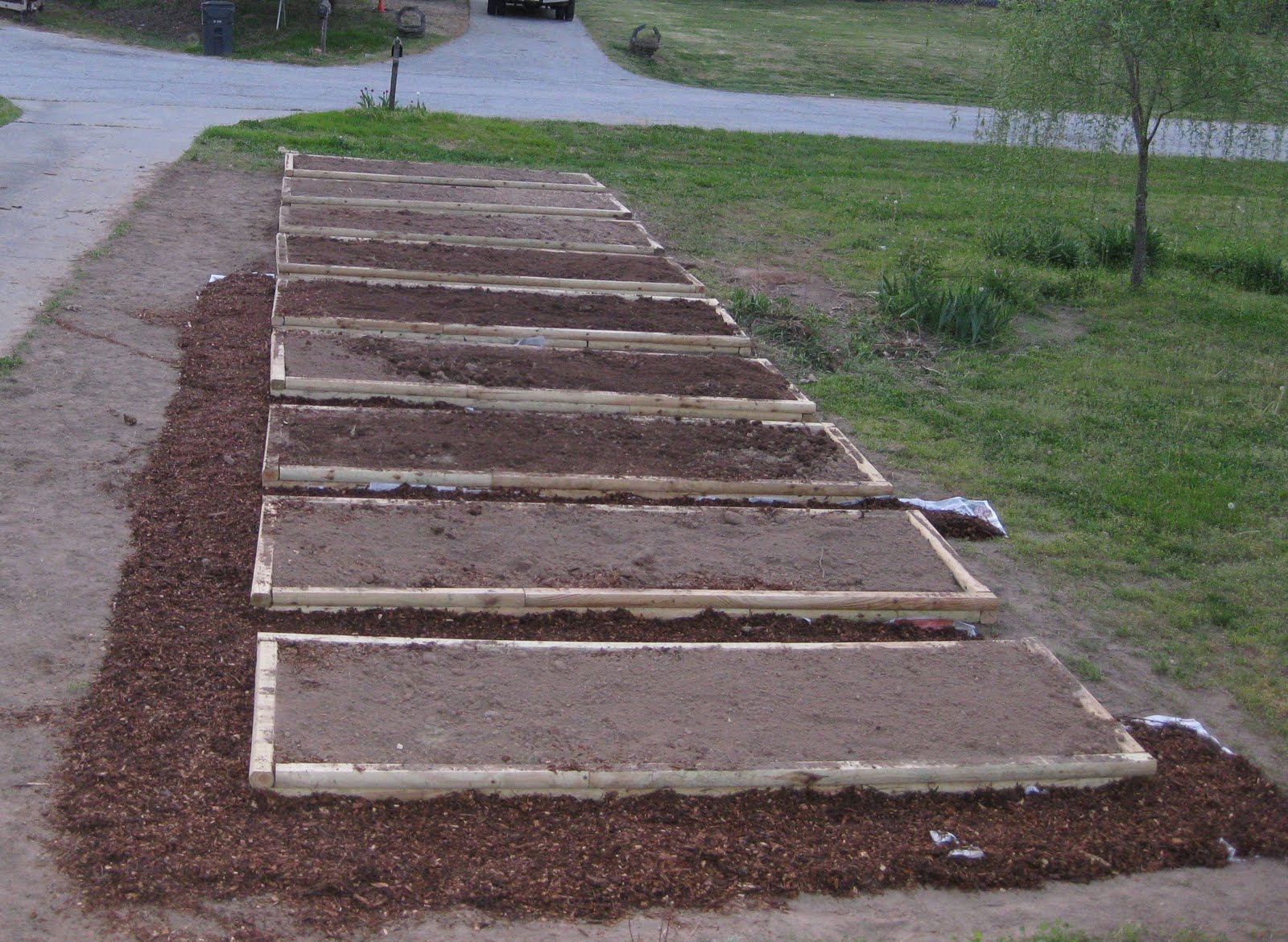
As you can see, the mulching isn't quite complete surrounding them. I'm laying down a layer of newspaper, followed by a thick layer of (free-yay!) mulch to help minimize the weeds. We'll see how that goes. :)
Next up is the fencing. We already have the 4x4 corner posts in, and also the metal posts too. This has been another big delay in planting the seedlings. I really don't want to get anything going before our fence is complete because we have major wildlife, and I'm not particularly interested in an open buffet for all our hard work. The first night we decided to start our garden, we had to wait to pull in our driveway for 7 deer to cross. Seriously. There are also lots of bunnies. Cute, but stay outta my garden.
Hopefully the fencing will go up this weekend, as we already have little seedlings emerging. I had been waiting and waiting, because our life schedule just doesn't lend itself to concrete planning. All you parents of small children know what I mean! I didn't want to bank on the fence going up and not get to it. But, I finally gave in for fear of too late a harvest. Our weekends are busy, and hubby doesn't get home until 7. The boys go to sleep at 8, so him doing outside work when he gets home means he doesn't see the boys really, and none of us enjoy that. We've sacrificed a night or two to get some things done though. They have 'helped' by sitting in the stroller outside while we worked a little. They particularly enjoyed when Daddy hammered in the posts. (They aren't really able to play/run around yet. Soon though.)
I'm already seeing some tomato and asparagus babies, and it's very exciting! I know we won't see much by way of the asparagus for about 4 years, but I'm really looking forward to the tomatoes :) Ooh! And the bell peppers too. Yum.
Sunday, April 11, 2010
Hello Dolly!
(Note: This is actually an older post...I thought I posted it awhile back, only to discover it was only a draft!)
My new All-American pressure canner came and I am really looking forward to using her! (Yes, it's a girl, and her name is Dolly.) I won't degrade my children by saying she's a new member of the family, but she will definitely be loved, respected and cared for. I chose the 21 1/2 quart because it seemed like the most practical for the cost. I can do 7 quarts at once, or 19 pints. It can also be used as a water bath canner, and as a pressure cooker for roasts and such. I didn't know that you could cook multiple foods at once in a pressure cooker without them taking on each other's flavors, did you? Interesting...
Anyway, I am planning a few pre-harvest recipes to familiarize myself with the canner. I don't want to be working out the kinks and have a learning curve when there's 20 pounds of tomatoes on the line. I would much rather mess up a small batch of strawberry preserves. That is the first thing I'm going to can. (Now, I know that my purpose in this is preserving in-season, yada yada yada, but I'm not concerning myself with that right now. I'm just learning. Plus, the only thing technically 'in season' right now are greens.) I also need to select something for regular pressure canning, because the water bath is a different technique, and I want to have tried both at least once.
Garden plans are in the works, news and pictures to come very soon!
Thursday, March 4, 2010
Garden Layout Plans
Well, we finally finished! Arranging the vegetable garden, that is. Technically, we haven't even ordered the seeds yet, but we're working on it. The plan was to have them ordered by March 1st...but last week was a rough week. Caleb and I got a bad stomache bug. Twice. Jacob had it once, and fortunately, Isaac never did. But anyway, we're selecting items and will hopefully order in the next couple of days. I'll share that list with you then. :) We've decided (after much deliberating) to order from Baker Creek Heirloom Seeds. There were several wonderful companies to choose from, but I wanted to order from one that not only supported what we believed, but actively didn't support genetic modification. They do just that, so there is no second-guessing when ordering! I know whatever we choose will be a wonderful selection that is non-hybrid (we could save seeds), non-GMO (Genetically modified), non-treated (chemical free) and non-patented (seriously, there are some crazy laws, check out the Food Inc. movie if you're ready...fair warning).
Our basic plan follows Eliot Coleman's suggestion for crop rotation, which teaches that plant families are impacted by being in the same location year after year, and by what precedes them when you do follow a crop rotation. Very interesting theory. He suggests an 8 crop rotation: potatoes follow corn, which follows cabbage - peas - tomatoes - beans - root crops - squash. And so on through a circle. Now, this is just an easy starting point of one all-inclusive rotation that works. He's very clear that you're not limited or required to have exactly 8 planting locations, but the general rules apply. Crop rotation is important in the prevention of disease. For most plants, keeping them in the same location every year will drastly increase your chances of fighting a disease and decrease your yield. There's some debate about tomatoes, as they don't show a yield reduction, and some suggest there's actually an increase when they are left in the same location. He states that he includes them because it works for him. We have chosen to exclude them from our rotation and give them their own bed with asparagus, basil and lavender. I'm including some pictures of our layout that we arranged with index cards. It made it really easy to visualize how much we had in one bed, and to rearrange to suit companion planting. (The idea that certain plants together can inhibit or encourage healthy growth.)


Our basic plan follows Eliot Coleman's suggestion for crop rotation, which teaches that plant families are impacted by being in the same location year after year, and by what precedes them when you do follow a crop rotation. Very interesting theory. He suggests an 8 crop rotation: potatoes follow corn, which follows cabbage - peas - tomatoes - beans - root crops - squash. And so on through a circle. Now, this is just an easy starting point of one all-inclusive rotation that works. He's very clear that you're not limited or required to have exactly 8 planting locations, but the general rules apply. Crop rotation is important in the prevention of disease. For most plants, keeping them in the same location every year will drastly increase your chances of fighting a disease and decrease your yield. There's some debate about tomatoes, as they don't show a yield reduction, and some suggest there's actually an increase when they are left in the same location. He states that he includes them because it works for him. We have chosen to exclude them from our rotation and give them their own bed with asparagus, basil and lavender. I'm including some pictures of our layout that we arranged with index cards. It made it really easy to visualize how much we had in one bed, and to rearrange to suit companion planting. (The idea that certain plants together can inhibit or encourage healthy growth.)

Now, I know that's hard to see, but I wanted you to see the big picture.
Now here are some close-ups.


I have tried to intersperse selected herbs that will complement some veggies. Chamomile seems to help everything - except other herbs! Who would've known? The onion family helps ward off harmful insects, as does mint, but mint tends to take over...so I'm leaving it out.
As for the physical design of the beds, we're following Ed Smith's suggestion for wide rows, with raised beds to create deep topsoil which will improve the overall health and yield of your plants. We're doing nine 4' x 12' beds, and we're opting to support them with a double row of non-pressure treated landscape timbers. They will be about a foot apart. In addition, we will be using supported trellising for all vine plants, including indeterminate (continually fruiting) tomatoes. Here is the trellis system that most resembles what we'll be building. (I'll include pics of that once we're up and running here on the homestead - lol) We're still discussing materials, but it's the general idea: vertical twine.

More details to come...happy gardening!
Wednesday, February 10, 2010
Can't wait to play in the dirt!
Whoa! I can't believe it's been almost a month since I last blogged! Well, time flies when you're...researching. Yup, that's what I've been up to. Isaac and I have massive plans for our yard this year. We're adding at least 8 garden beds, taking up over half the fence, and looking to level and fill some holes. Needless to say, this will be a big undertaking. We haven't been able to do nearly what we'd like with our yard since the boys were born so soon after we moved. So we are looking forward to this spring because we will actually be able to get our hands dirty and be productive!
Hence the researching. I'm a researching addict, I fully admit it. So the last month (Isaac says 2) I have been placing lots of holds at the library, picking up and dropping off lots of books, and pretty much spending all my free time reading about gardening. I know I'll learn many things through only experience, but I like to know what I'm jumping into. Especially when there's money invested. :) My favorite book has been The Vegetable Gardener's Bible. Super easy and fun to read with lots of great info, but also not overwhelming. (I found a few of those, and trust me, they went right back to the library!) So much I have to learn... I've also used the Mother Earth News site and Grit a lot for referencing, short articles and book suggestions. I've requested some organic and heirloom seed catalogs too. There are so many varieties out there and our local grocery stores offer so few! It's going to be hard to narrow it down, even with a whole 4 x 12 bed for each plant family. Did you know there are over 3,000 varieties of apples? Who knew carrots came in purple, red, striped, white and yellow too? It's crazy, I tell you.
Oh, and I've also been researching canning, preserving, freezing and drying. Isaac wants to build a solar dehydrator. (Seriously, if you'd told me 10 years ago that I'd be here, I would have laughed...) We're purchasing a pressure canner and supplies and building a pantry to store the jars. I'm also trying to win a grain mill because it turns out they are rather expensive. I can only enter the drawing once, so please feel free to enter yourself on my behalf. I would be beyond excited...because really, how fun is harvesting my own grain going to be this fall if I can't do anything with it?
As we begin these activities, it's been amazing the things God has begun to show us. Isaac said he had always thought of stewardship in terms of money. You know, if you can't be trusted to handle 10 dollars well, why would you be given 10,000? But then he realized we both have mentioned countless times how much we'd love to have a large parcel of land but have yet to do much with our 1 1/3 acres. Now, I don't think we were being disobedient this last year while the boys were young, but we are going to make our land fruitful and use it for more than just lots of mowing. I'm not hopping on the anti-government conspiracy theory wagon that I have to be completely self-sustaining and off the grid, but I think being less reliant is good. I mean, sure, we could go a couple days should a disaster strike, but beyond that, well... Basically, we just want to have more control over our lives and health. Plus, we both think it would be really good for the boys to grow up in an environment where it's normal to provide for yourself and also to question where their food comes from. They could learn how to garden from a young age, and that will give us many opportunities to teach them life lessons. Next year...chickens. Seriously :)
Tuesday, November 3, 2009
You could make that, Lee
*edited 7/21/2010:
After using the following recipe for awhile, I have fiddled around and improved it. I found the ivory left a residue, so I switched to fels naptha laundry soap. I LOVE it! It rinses so clean, I noticed an immediate difference. Here is my new adjusted recipe. All directions are still the same, and I now use this as my pre-spot spray too.
1/2 bar fels naptha
1 C borax
1 C washing soda
HOT water
My Grandmother lived with me until I was 9, which I consider a wonderful privilege. She taught me many things, one of which was that there are many things I can do myself and it's not sensible to always be paying for them. Sometimes my mother and I have found this humorous however, because we draw the line in some areas. (While we very well may be able to do that, it's hard to beat buying something for $5 that would have taken us 5 hours to make and probably wouldn't have looked as nice.) That being said, what her generation knew is that it pays to be frugal, self-sustaining and to live with some just plain common sense. Such as, if I can make laundry soap myself, in 20 minutes, and it costs me less than 1 cent a load, why would I pay over 50 cents a load at the store? That one is definitely on my side of the line. And, quite frankly, I think my homemade baked goods and my mother-in-law's bread are better than anything I can buy in the store. Plus, they're so much cheaper!
I was making a new batch of laundry soap for my dad this morning and I was thinking how grateful I am for this small blessing in my life. Sometimes the daily rhythm of chores is very comforting to me, and this was one of those times. The following is the recipe I use for laundry detergent (courtesy of my wonderful MIL). I really love this stuff and feel it is every bit as good as the store bought, with the exception that it actually has less chemicals and my nose doesn't run because it's not filled with perfumes. Oh, and I use it as a concentrated presoak too and it hasn't met a stain it couldn't best.
1 bar of ivory soap, shaved
1 cup of washing soda (not baking)
1/2 cup of borax
Also, you can pour the soap in half gallon jugs if it's easier to measure and handle. However, if you have enough room in your laundry room, I recommend just keeping the bucket right beside your washer. I keep a 1 cup measuring scoop sitting right on top of the lid. Whenever I'm washing I use the scoop to swish the soap around, scoop it out, and rinse it off in the running washer water and set it right back on top of my bucket. This works best for me and I haven't noticed it ever separating badly. If your water is hot enough when you make it, your soap should be pretty even, but kinda goopy. So, if it's goopy, you did it right. Just make sure it's evenly goopy and there's not a lot of water sitting at the bottom or top of your bucket.
I plan in the near future as I run out of my soap stock to try some other money-saving recipes I've researched. Dish washing detergent, dish soap, hand soap, shampoo and body wash reviews will hopefully be appearing soon...
After using the following recipe for awhile, I have fiddled around and improved it. I found the ivory left a residue, so I switched to fels naptha laundry soap. I LOVE it! It rinses so clean, I noticed an immediate difference. Here is my new adjusted recipe. All directions are still the same, and I now use this as my pre-spot spray too.
1/2 bar fels naptha
1 C borax
1 C washing soda
HOT water
My Grandmother lived with me until I was 9, which I consider a wonderful privilege. She taught me many things, one of which was that there are many things I can do myself and it's not sensible to always be paying for them. Sometimes my mother and I have found this humorous however, because we draw the line in some areas. (While we very well may be able to do that, it's hard to beat buying something for $5 that would have taken us 5 hours to make and probably wouldn't have looked as nice.) That being said, what her generation knew is that it pays to be frugal, self-sustaining and to live with some just plain common sense. Such as, if I can make laundry soap myself, in 20 minutes, and it costs me less than 1 cent a load, why would I pay over 50 cents a load at the store? That one is definitely on my side of the line. And, quite frankly, I think my homemade baked goods and my mother-in-law's bread are better than anything I can buy in the store. Plus, they're so much cheaper!
1 bar of ivory soap, shaved
1 cup of washing soda (not baking)
1/2 cup of borax
- Bring a pot of water (2-3 quarts) to boil.
- Reduce to medium heat. (Boiling makes the soap foam.)
- Slowly sprinkle shaved ivory soap until completely melted. Take your time. Dumping the whole pile of shavings will actually take you longer.
- Add about 4 gallons of HOT water to a 5 gallon bucket.
- Pour pot of soapy water in the 5 gallon bucket too and stir well.
- Add washing soda and borax to hot water mixture and stir well.
- Put lid back on bucket and let sit overnight.
- Stir well the next day.
Also, you can pour the soap in half gallon jugs if it's easier to measure and handle. However, if you have enough room in your laundry room, I recommend just keeping the bucket right beside your washer. I keep a 1 cup measuring scoop sitting right on top of the lid. Whenever I'm washing I use the scoop to swish the soap around, scoop it out, and rinse it off in the running washer water and set it right back on top of my bucket. This works best for me and I haven't noticed it ever separating badly. If your water is hot enough when you make it, your soap should be pretty even, but kinda goopy. So, if it's goopy, you did it right. Just make sure it's evenly goopy and there's not a lot of water sitting at the bottom or top of your bucket.
I plan in the near future as I run out of my soap stock to try some other money-saving recipes I've researched. Dish washing detergent, dish soap, hand soap, shampoo and body wash reviews will hopefully be appearing soon...
Friday, October 2, 2009
It's Not Easy Being Green
I wouldn't say I've lived a posh lifestyle with complete disregard to the environment, throwing endless things away for convenience, but I definately could do better. Mostly I would attribute it to a lack of knowledge, not lack of caring. However, in the last 6 months or so my eyes have been opened to some things that I hadn't noticed. It started with my homemade laundry soap (courtesy of the Webster clan) and a daily awareness of wastefulness and reliance on manufacturing. Then, I found the book Green Housekeeping. Wow! So wonderful! Now, I will say there's some things in there that are a little over the top for me, but it has educated me greatly.
Now, I need to make a disclaimer: I am in no way saying I live the ultimate green life. But I am trying a little bit at a time to transform my way of thinking and living to better my children's future. Notice I did not say 'save the planet'. To be frank, this statement irks me because I think it's ridiculous. George Carlin may be crass, but he's not so far off to say we are egotistical to think the planet needs our saving - it doesn't. Now, before you get defensive thinking I'm saying eco living is hogwash, I'm not saying that at all. The planet will go on fine for many years until it's swallowed up by the sun. We as a race, however, will be in a mess of trouble. That's my point - live with a conservative mindset to better our futures and make ourselves more self-reliant. That's the mental direction I'm heading, one step at a time.
My mom told me about an article she read (I have no idea where) in which a man saved all his trash for a year. Yowza! He realized a vast majority of it was product packaging and food waste. I would love to compost but at the moment I am too cheap to spend money on a compost bin. Shame on me. Christmas gift anyone? It really made me contemplate how I purchase things and what I do with the packaging. I have begun to change my purchasing choices based on this fact. I have also started saving a lot of packaging and creatively repurposing it throughout my home. I love to organize, so I can't complain about my lovely assortment of boxes, bins, jars and bottles. Something very fun I have begun to do is use these in drawers as custom organizers. I love all the little plastic ones you can buy, (oh, the Container Store...) but they are expensive and I just can't rationalize it when I can do this for free. Plus, there's a greater variety of sizes. It may not look as 'pretty' but I'm much more satisfied reusing these boxes than throwing them away and buying more plastic. It could use some fine tuning, but here's what I did with my kitchen junk drawer:
![]()
![]()
Now, I need to make a disclaimer: I am in no way saying I live the ultimate green life. But I am trying a little bit at a time to transform my way of thinking and living to better my children's future. Notice I did not say 'save the planet'. To be frank, this statement irks me because I think it's ridiculous. George Carlin may be crass, but he's not so far off to say we are egotistical to think the planet needs our saving - it doesn't. Now, before you get defensive thinking I'm saying eco living is hogwash, I'm not saying that at all. The planet will go on fine for many years until it's swallowed up by the sun. We as a race, however, will be in a mess of trouble. That's my point - live with a conservative mindset to better our futures and make ourselves more self-reliant. That's the mental direction I'm heading, one step at a time.
My mom told me about an article she read (I have no idea where) in which a man saved all his trash for a year. Yowza! He realized a vast majority of it was product packaging and food waste. I would love to compost but at the moment I am too cheap to spend money on a compost bin. Shame on me. Christmas gift anyone? It really made me contemplate how I purchase things and what I do with the packaging. I have begun to change my purchasing choices based on this fact. I have also started saving a lot of packaging and creatively repurposing it throughout my home. I love to organize, so I can't complain about my lovely assortment of boxes, bins, jars and bottles. Something very fun I have begun to do is use these in drawers as custom organizers. I love all the little plastic ones you can buy, (oh, the Container Store...) but they are expensive and I just can't rationalize it when I can do this for free. Plus, there's a greater variety of sizes. It may not look as 'pretty' but I'm much more satisfied reusing these boxes than throwing them away and buying more plastic. It could use some fine tuning, but here's what I did with my kitchen junk drawer:

I don't have a before picture, but I'm very pleased with the results. I mean, what does your junk drawer look like? If it's like something out the Container Store catalogue, I don't want to hear about it. On second thought, go ahead and post a pic, I'll live vicariously through your pretty drawer...
Now, I make a lot of my own baby food, but I don't make all of it. Therefore, I have quite the collection of baby food jars. These are wonderful for so many things! One of my recent repurposes for these were some homemade decorative pumpkins. I have been oogling the ones in stores, especially the ones made out of grapevine. But I don't have any grapevine. I do have lots of kudzu I just might try drying out though... Anyway, I had also seen some cute fabric ones that I like but once again, I'm just too cheap to spend money on something I really don't need. So, the other day when the boys were particularly happy, I rummaged through my stash and came up with these:

They weren't really the fabric I wanted, but I didn't purchase anything to make these. I took 3 baby food jars of different sizes, stuffed a square of fall colored fabric around and in to the center. Then I took a torn piece of cardboard and rolled it up for a stem. The leaves are from a silk fern I had left over from a floral project. The bows are rafia and for a finishing touch I wound some gold wire around a pencil to use as a curly vine. Overall, I was pretty happy with my makeshift pumpkins.
I'm really enjoying this transition in my life and I'm looking forward to new creative ideas for a self-sustaining lifestyle. I only have 1 1/3 acres, so I won't be buying a dairy cow or chickens anytime soon, but I hope to start a garden next year. I'm definately doing an herb garden - I want lots of lavender. What are some of your favorite ways that you try to live green? Thanks for sharing!
Subscribe to:
Posts (Atom)